Thursday, November 15, 2018

Sexually Transmitted Diseases (STD)

Each and everyone of us has heard the dangers of STDs, but how many of us really know everything there is to know about these? These diseases are transmitted from people to each other during sexual intercourse. These diseases are transmitted during any form of sexual intercourse, be it vaginal, anal or even oral. But remember, it can be contracted only when a person indulges in sexual intercourse with another person who already had an STD, but there are some like scabies, which can be passed through contact as well. They are sometimes referred to as STI, which stands for sexually transmitted infection. The reason this term is used is because there are cases like those in chlamydia, where an STD is similar to an infection.

There is no immediate understanding of these diseases. One has to always be on the lookout for symptoms. One should be more aware of the symptoms, if his/her partner has one of these sexually transmitted diseases. It is best to get these treated as soon as possible so as to avoid any further complications that may arise out of non-treatment, such as infertility. In some cases, it can be transmitted from a mother to her unborn child, which can be avoided through proper treatment.

Different Types of STDs

Bacterial Vaginosis
Though this cannot be in strict terms be called an STD, it is a disease that cannot be transmitted though sexual intercourse, but can be aggravated because of it. BV is an STD that affects only women and can be detected only because of the strange fishy smelling discharge. No one knows how BV starts, but it is said that it can be caused due to the acidic imbalance in the vagina, and this could be because of semen or intrauterine contraceptives. BV cannot be passed on to a man, but treatment has to be prompt so as to avoid serious damage to the uterus and fallopian tubes.

Chlamydia
This Sexually transmitted infection is the most common, and occurs because of the presence of chlamydia trachomatis bacterium in the body. It can affect both men and women and if it is not treated properly can cause infertility. Chlamydia is transmitted through sexual intercourse and also through genital contact. The best way to cure chlamydia is to get help as soon as possible.

Crabs
Crabs are pubic lice that are called so because of their crab like appearance. These lice are extremely tine and can barely be seen by the naked eye, and are found on rough body hair like the pubic hair, armpit hair and even facial hair. These crabs or lice are grayish yellow in color and grab at hair strands with their claws. Crabs can easily be passed on through sexually intercourse and sharing of clothes, bedding and towels. Symptoms of crabs are - itching of the skin, inflammation of skin and spots of blood from where the lice have been feeding. Treatment of crabs is easy and does not require removal of hair.

Genital Warts
These are warts or bumps caused on the skin, normally in the genital area by some form of human papillomavirus (HPV). These warts are large, flesh colored and painless. They will itch and may be difficult to find and this is why most people do not even realize they have genital warts. In case a woman has genital warts on the cervix, it can lead to discharge and bleeding. It is important to get the right medical attention for genital warts.

Gonorrhea
Once known as clap, this is an infection that can infect the urethra, cervix, rectum, anus and even the throat. The symptoms are:

Burning while urinating.
Discharge from penis that is white or yellow in color.
Change in color of vaginal discharge.
Discharge from the anus along with irritation.

Herpes
Herpes can be caused by two different types if viruses. The HSV-1 virus affecting the genital and anal regions and the HSV-2 affecting the mouth and lips a lot like cold sores. HSV-2 is a more common form of STD and research claims that one out of every five Americans gets herpes. There are some symptoms of herpes, these are:

Itching and tingling of the genital and anal area.
Blisters and sores.
Pain while urinating, especially in women.
Headaches and backaches, also accompanied by flu-like symptoms.

Syphilis
This is a common bacterial infection that is caused by the bacteria treponema pallidum, which was once known as pox. It is a sexually transmitted disease but can also be transmitted from a pregnant woman to her unborn child. If syphilis is not treated in time, it can become more severe and sometimes lead to death. There are various stages of syphilis. There are symptoms of syphilis, these are:

Ulcers that are painless but occur on the genital region, anus and mouth.
Lumps in the groin.
Rash that isn't itchy.
Fever and other flu-like symptoms.

These were the different types we saw. You must understand the severity of these diseases. If not treated in time, they can be horrible to live with. This tells us the amount of awareness we should have regarding our health. Do not self-diagnose, consult a doctor as soon as you see any sign or symptom mentioned above.

Half Of Reproductive-Age Women Want Easier Access To Abortion Pills, Study Finds

In a new survey, nearly half of 7,000 women said they were interested in new ways to get the abortion pill.The survey shows many women want the two medications to be available over the counter or online. Nearly half want doctors to provide the pills in advance.
 
Zhang Rong via Getty Images
In a new survey, nearly half of 7,000 women said they were interested in new ways to get the abortion pill.

A new national survey released Thursday shows substantial support for greater access to medication abortion among women in America.
Currently, a woman who wants to take the abortion pill — actually a combination of two drugs — must go to a medical facility where she takes the first medicine, mifepristone, in front of a clinician, and the second, misoprostol, at home some hours or days later. 
But in the new survey of more than 7,000 reproductive-age women, 49 percent said they supported at least one of three models for obtaining the abortion pill. Forty-five percent said they supported getting the drugs in advance from a doctor for potential use down the road, 37 percent said they believed the drugs should be available over the counter and 30 percent said they supported making the pills available to women online.
And when asked whether they’d consider using any of those methods personally, nearly a quarter of the women said they’d consider getting the pills in advance from a doctor or obtaining them over the counter, while 16 percent said they’d be interested in buying the pills online.
“If we consider that this is a representative sample of adult, reproductive-age women across the US — many of whom may not support abortion at all, may never have considered having an abortion themselves, or may never need an abortion — the proportion in favor of these models is extremely high,” study author Antonia Biggs, a social psychologist researcher, said in an email to HuffPost. “When we exclude the women who are morally and legally opposed to abortion rights, levels of support increase to 62 percent.”
Since Brett Kavanaugh’s appointment to the Supreme Court put reproductive rights advocates on high alert about the future of Roe v. Wade, there has been a frenzy of activity around making self-induced abortion safer for women — particularly through increased access to the abortion pill.
When we exclude the women who are morally and legally opposed to abortion rights, levels of support increase to 62 percent. Antonia Biggs, study author
Before Roe v. Wade legalized abortion in all 50 states in 1973, more than 1 million illegal abortions may have been performed in the United States each year — many of them deadly. American women went to Mexico to have surgical procedures, traveling alone in cars with strangers to see providers they knew nothing about. They used coat hangers and even drank bleach. The abortion pill has fundamentally changed the nature of so-called “back alley” abortions, but many reproductive rights advocates believe access is still far too limited.
Subscribe to The Morning Email.
Wake up to the day's most important news.
Earlier this fall, the founder of Women on Web — an organization that has long helped women outside of the United States perform their abortions at home — told The Atlantic she had been quietly shipping abortion pills to women in this country for more than six months through her new organization, Aid Access. Like Women on Web, it not only sells women the medications but also provides them with online consultations to walk them through the process.
Right around that time, the Sia Legal Team — which works with women who have induced their own abortions — announced the launch of a free helpline for women who have been questioned by the police about ending their pregnancies (or who fear they might be), as well as a website with information about the legal landscape surrounding self-managed abortions. In some states, women have been prosecuted and jailed for attempting to terminate their pregnancies.
“Before abortion was declared legal by the Supreme Court more than 40 years ago, finding a safe abortion was really difficult,” Jill Adams, SIA’s strategy director, told HuffPost. “But now people who can get abortion pills have a safe option to end a pregnancy on their own. In this scenario, and in this age, the risk is legal; it’s not physical. The image of the coat hanger has been supplanted by the image of handcuffs.”
There is research backing the safety of largely self-managed abortions, although these studies have not necessarily examined the safety of women going it entirely alone. A 2017 investigation found, for example, that abortions are just as safe when managed remotely via telemedicine as they are when a clinician actually watches a woman take the first pill.
What this all means for the future of self-managed abortions in the United States is uncertain.
In an email to HuffPost, the Food and Drug Administration said it “takes the allegations related to the sale of mifepristone in the U.S. through online distribution channels very seriously and is evaluating the allegations to assess potential violations of U.S. law.” The FDA said it was unable to discuss potential or pending investigations, if any exist.
A spokesperson for the American College of Obstetricians and Gynecologists said the organization does not have an official stance on Aid Access, though it has urged the FDA to remove certain restrictions on where a woman is able to access mifepristone, given the medication’s track record of safety and efficacy. The group has also come out strongly against the criminalization of women who end their pregnancies.
But the new survey suggests that interest from women is there. 
“We really knew little about the demand for and interest in alternative models (advance provision, online access, and over-the-counter access) of medication abortion provision,” said Biggs, a researcher at Advancing New Standards in Reproductive Health, at the University of California, San Francisco. 
“We would not expect these alternative models to meet the needs of all women,” she added, “but do feel that by offering women more options, we are more likely to meet the needs of most women.”

Justice Department Preparing To Prosecute WikiLeaks Founder Julian Assange: WSJ

DOJ expects to soon prosecute Assange, who has been living in London, reports The Wall Street Journal.


The U.S. Justice Department said it is planning to prosecute controversial WikiLeaks founder Julian Assange.
Sources told The Wall Street Journal on Thursday that the department is also hopeful it will get Assange ― who has been holed up in an Ecuadorean embassy in London since 2012 ― into a U.S. courtroom.
Assange fled Sweden in 2012 over allegations of sexual assault and rape. Though prosecutors dropped the case last year, he still faces arrest for breaching bail conditions should he leave the embassy.
Then-Attorney General Jeff Sessions said in April 2017 that the arrest of Assange would become a priority for the Justice Department.
U.S. intelligence agencies believe that WikiLeaks coordinated with Russian hackers to release emails stolen from the Democratic National Committee during the 2016 presidential campaign. Special counsel Robert Mueller is reportedly investigating connections between WikiLeaks and Roger Stone, a longtime adviser to Donald Trump before he became president.
Do you have information you want to share with HuffPost? Here’s how.

Donald Trump Is Still The Favorite To Win In 2020 — Just Look At The Midterm Map


Despite inheriting a roaring economy from President Barack Obama, President Donald Trump has been underwater in national job approval polls since he took office on Jan. 20, 2017.
Since 1938, Gallop has asked the nation, “Do you approve or disapprove of the way the president is handling his job?”
Across 80 years of polling, presidents have averaged approval ratings of 53 percent, ranging from a high of 74 percent for John F. Kennedy in November 1962 to a low of 35 percent for Trump in December 2017. In the days leading up to the 2018 midterm elections, Trump’s approval rating rose slightly to 40 percent. Still, a commanding 54 percent of those polled said they disapproved of Trump’s performance. His low approval ratings contributed to the resurgence of the Democratic Party in the House, where they picked up at least 33 seats and regained control of the chamber.
Record turnout and pointed campaigning in battleground states also helped Democrats pick up Senate seats in Arizona and Nevada, which would have been enough to take control of that chamber if all the party’s incumbents there had held on to their seats.
Instead, the chambers swung in opposite directions, with Republicans building on their majority in the Senate. They have already secured a 51-seat majority in the upper chamber and look likely to add two seats ― Florida and Mississippi ― by the time the dust settles. 
If the GOP’s success in the senatorial elections is a sign of anything, it is this: Regardless of what the country thinks of Trump or whom the majority of the country votes for, the current president maintains a very good chance of winning a second election in 2020.

Trump’s Advantage

The key to Trump’s success is rooted in the unequal distribution of racial and ethnic groups across the Electoral College system. This arrangement allows him to target favorable demographic windows that lean hard to the right and exploit them to his party’s advantage. This is how he won in 2016. And this is how his party beat incumbent Democratic senators in Indiana, Missouri and North Dakota in the midterm elections this year. And if he wins again in 2020, this demographic advantage will lie at the center of his success.
As I argued here last month, migration of minorities out of rural states has demographically structured the United States such that the Electoral College favors not only rural states, as it was designed to do, but also conservative white voters who reside in greater numbers in rural regions of the country. As a result, instead of balancing power across rural and urban states, the Electoral College creates opportunities for ultraconservative factions to enter the national stage. 

People who support the Electoral College typically argue that the system was designed to provide rural regions of the country with equal representation. While this is at least partly true, it is important to keep in mind that when the Electoral College was devised, the only people who could vote were white males. And although white women gained the right to vote in 1920, minorities in the U.S. didn’t gain full citizenship until the Voting Rights Act was passed in 1965. By that time, demographically, the U.S. was a very different place from in 1787, when the founders drafted the Constitution.

Since Aug. 1, 2018, Trump has held 33 campaign-style rallies, targeting states with rural, white populations and higher than
Jeff Swensen via Getty Images
Since Aug. 1, 2018, Trump has held 33 campaign-style rallies, targeting states with rural, white populations and higher than average approval ratings for the president.

Early statesmen never could have envisioned the degree to which the Industrial Revolution would affect the distribution of residents across rural and urban settings. According to the Census Bureau, in 1800, 94 percent of the country lived in a rural setting. By 1900, that number dropped to 60 percent. Today, over 80 percent of U.S. residents live in an urban setting.
While people from all racial and ethnic backgrounds left the countryside in search of opportunities from 1800 to 2018, as a percentage of their population, minorities left at much higher rates than whites. The unequal migration of people out of rural America helps us make sense of Trump’s victory in 2016 as well as Republicans’ ability to retain the Senate in 2018, despite their significant loss in the national popular vote for the House. 
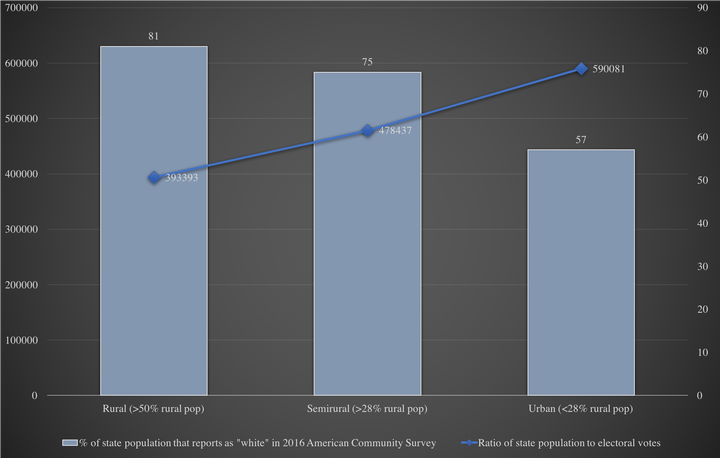
As Graph 1 illustrates, in states where at least 50 percent of the population lives in a rural setting, 81 percent of residents are white, which is 19 percentage points higher than the national average (62 percent) reported in the 2016 American Community Survey. The number of white residents drops to 57 percent in urban states. This trend is inverse to the ratio between electoral votes and population. That is, rural states average one electoral vote for every 393,393 people. In contrast, predominantly urban states average one electoral vote for every 590,081 residents. In practical terms, individuals living in whiter, rural states have 50 percent more representation in presidential elections than people living in urban states.
Graph 1: Average population per electoral vote in rural, semirural and urban states

The bars show the percentage of white voters in rural, semirural and urban states. The line represents the average number of
Benjamin Waddell
The bars show the percentage of white voters in rural, semirural and urban states. The line represents the average number of voters represented by each electoral vote. *The white population depicts individuals who identified as non-Hispanic white in the 2016 American Community Survey; data via FactFinder.Census.gov.

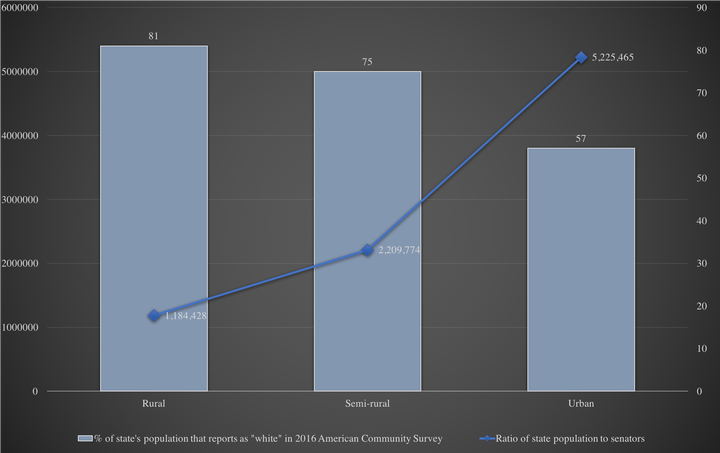
As Graph 2 shows, representation in the Senate is even more skewed. In urban states, there is one senator for every 5,225,465 residents, compared with one senator for every 1,184,428 residents in rural states. As a consequence, people living in rural (whiter) states have 341 percent more representation in the Senate than people living in urban states.
Graph 2: Average population per senator in rural, semirural and urban states

Benjamin Waddell

Subscribe to The Morning Email.
Wake up to the day's most important news.
This arrangement wouldn’t be so pernicious if racial and ethnic minorities voted consistently across party lines, but that’s not the case. All minority groups — without exception — vote predominantly for Democratic candidates in major elections. In fact, in the 2018 midterm elections, ethnic and racial minorities favored Democrats by an average margin of nearly 60 percentage points. Put simply, no factor in American politics predicts voter outcomes across party lines better than race. And this is particularly true in rural America, where white voters show a strong preference for Trump and his party.
Thus, while the Electoral College may have been designed to equalize representation across rural and urban states, as it currently exists, the system systematically favors white voters living in sparsely populated areas of the country.
And nobody seems to understand this better than Trump, who, since Aug. 1, 2018, has held 33 campaign-style rallies across the United States. He has used his rallies to target states with rural, white populations and higher than average approval ratings for the president. While 62 percent of the nation identifies as white, the states he has targeted in recent rallies average 72 percent white. And while his approval ratings hover around 40 percent nationally, in rally states, his ratings average 50 percent.

The Obama Effect

Obama is often cited as evidence of a colorblind electoral system. And while he was the first black president of the United States, it is important to keep in mind that he is a quintessential outlier. He won the presidency twice, and in each election he pulled enough votes in key electoral states to gather more than the needed 270 electoral votes.
Still, he was a once-in-a-generation candidate. He is a gifted speaker, compassionate father and expert statesman and is extremely talented at navigating highly contentious political matters with grace. While Obama’s presidency clearly represents a breakthrough moment in the long road to racial equality, it’s simply misleading to imply that his election is evidence of a colorblind society.
To be fair, Obama’s success demonstrates that race isn’t an absolute barrier to the Oval Office. However, as Trump clearly shows, in the right election cycle, it can be. The 2016 election is a great case in point.
Obama’s victories in 2008 and 2012 distract from the fact that American presidential elections are predominately decided by swing voters in a handful of states where, in most election years, a large majority of residents are white. In 2016, for example, three states decided the election: Michigan, Wisconsin and Pennsylvania.
According to the Census Bureau, 76 percent of the population in Michigan is white, 82 percent in Wisconsin and 78 percent in Pennsylvania. These numbers grow when we look at voting-age populations. Whites account for 79 percent of the voting-age population in Michigan86 percent in Wisconsin and 81 percent in Pennsylvania.

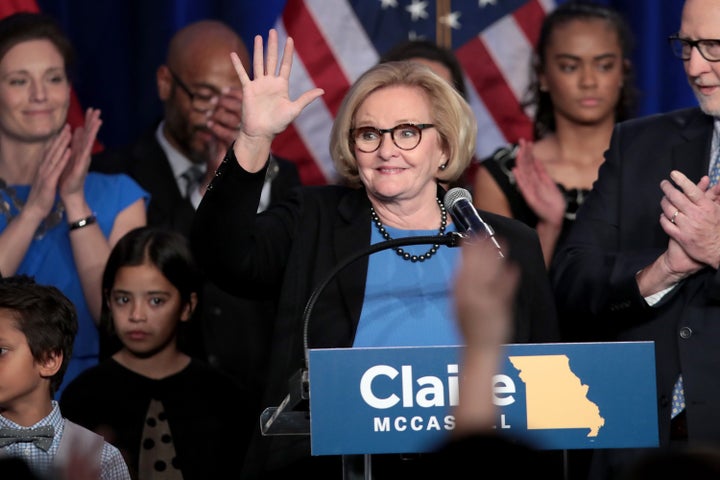
Sen.Claire McCaskill of Missouri was one of at least three Democratic incumbents who lost in states that are whiter than the
Scott Olson via Getty Images
Sen.Claire McCaskill of Missouri was one of at least three Democratic incumbents who lost in states that are whiter than the national population.

Obama won each of these states in 2008 and 2012, but his success was largely the result of record turnout among young voters and his ability to pull moderates to his side of the aisle. But more important, he had favorable Electoral College windows. That is, the combination of states that ultimately decided the election did not work against him.
In 2008, the closest states were Indiana (80 percent white), Ohio (80 percent), North Carolina (64 percent) and Florida (56 percent). Across these four states, 73 electoral votes were in play.
In 2012 the closest races were in Ohio (80 percent white), Virginia (63 percent) and Florida (56 percent). Together, these states have 60 electoral votes.
Combined, the demographic makeup of each of these groupings was more in line with the country’s national population. However, in 2016 that changed when Michigan, Wisconsin and Pennsylvania emerged as the most important states in the election. This combination placed the fate of the presidential election in the hands of three states with higher than average populations of white voters, and in doing so, it created the perfect demographic window for Trump. 

A recent study on white swing voters in the 2016 election found that “white voters with racially conservative or anti-immigrant attitudes switched votes to Trump at a higher rate than those with more liberal views on these issues.” Other authors have come to similar conclusions, finding that racial resentment played a clear role in Trump’s success in 2016.
And all available evidence points to a similar advantage in the 2018 midterms.

The Midterm Elections

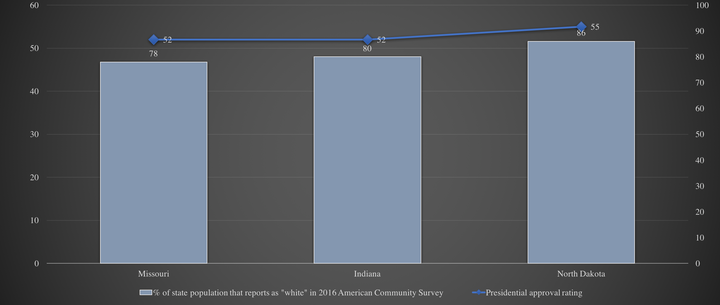
Trump’s party flipped three states in the Senate: Indiana, Missouri and North Dakota. Not surprisingly, as Graph 3 shows, the president’s approval ratings as of October 2018 were higher than average in these states. In Missouri, where 78 percent of residents are white, 52 percent of voters approved of Trump’s performance. In Indiana, which is 80 percent white, 52 percent of voters approved of the president, and in North Dakota, which is 86 percent white, Trump registered an approval rating of 55 percent.
Graph 3: White population and Trump approval ratings across Senate seats flipped by Republicans

The bars show the white population percentage in Missouri, Indiana and North Dakota. The line shows Trump's approval rating i
Benjamin Waddell
The bars show the white population percentage in Missouri, Indiana and North Dakota. The line shows Trump’s approval rating in each state, all above the national average.

After the 2016 election, it seemed likely that Trump’s demographic window might close if minorities and young people went to the polls in higher numbers. In the midterms, both groups voted in record numbers, contributing to Democratic flipping of Republican-held seats in Arizona and Nevada. Nonetheless, Republicans were able to retain control of the Senate by flipping seats in whiter states.
That’s the power of the Electoral College.
We live in a nation that is deeply affected by racial inequalities, and we elect presidents and senators in a system that favors a handful of states where white, conservative voters make up the clear majority of eligible voters. This explains how openly racist candidates with “alt-right” tendencies like Trump have been elected in recent years. And barring no major changes to the electoral landscape, it explains why more leaders of this nature may be elected in the future.

Future Elections

Although diversity is on the rise across the U.S., including in rural areas, minority populations tend to be much younger than the majority group. In 2015 the median age for minorities in the U.S. was 31, whereas for whites, it was 43. In the 2016 election, the median age of voters was 47.5. And Trump cleaned house with voters in the 45 and older group, where he held an 8 percentage point advantage over Hillary Clinton. She maintained a 14 point advantage with 18-to-44-year-olds.
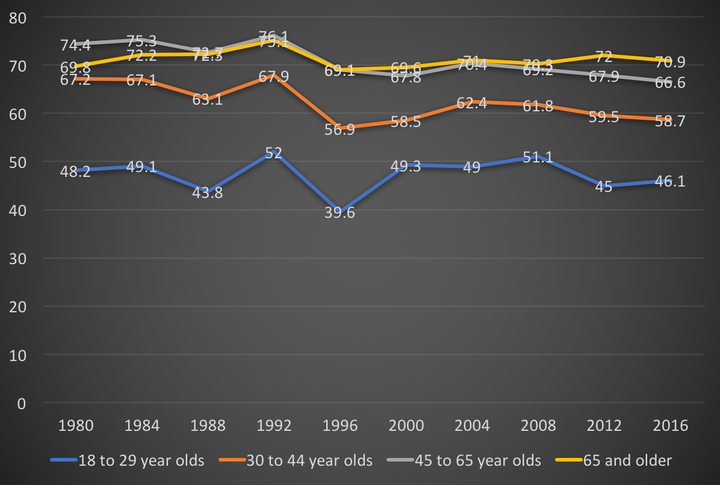
So what made the difference in 2016? Young people and young people of color in particular didn’t turn out to vote at the same rates as white voters. Graph 4 illustrates voter turnout from 1980 to 2016 by age group.
Graph 4: Voter turnout by age group, 1980 to 2016

Benjamin Waddell

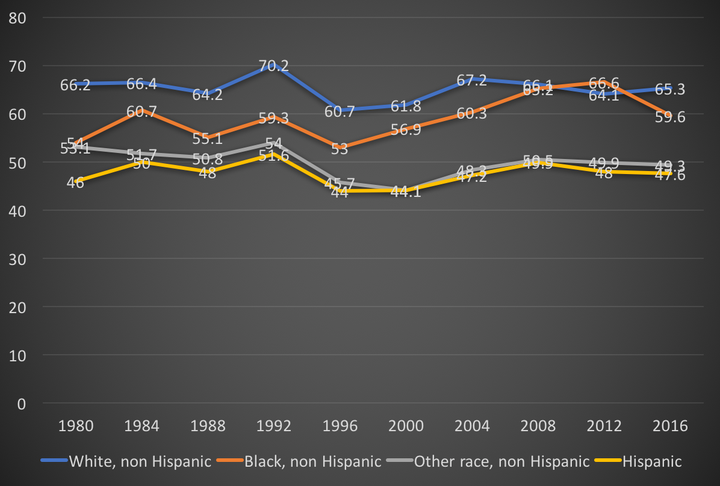
Graph 5 shows voter turnout across racial and ethnic groups. Non-Hispanic whites go to the polls at much higher rates than other racial and ethnic groups. Black, non-Hispanic voters also turn out at high rates, but their rate fell sharply, from 66.6 to 59.6 percent in 2016, whereas white rates rose, from 64.1 to 65.3 percent. Hispanic and other ethnic groups have consistently voted at substantially lower rates.
Graph 5: Voter turnout by racial and ethnic group, 1980 to 2016

Benjamin Waddell

In the long run, as larger minority populations in rural states reach voting age, representation through the Electoral College may begin to reflect the nation’s actual demographics again. However, in the short run, we are trapped in an electoral system that devalues minority voices.  
We are hardly doomed. A new era of American politics is in on the horizon. The real question is how much damage the Electoral College does to American democracy in the meantime. In 2016, Trump slipped through the perfect demographic window, and in 2018 his party used the same advantage to improve its majority in the Senate. It’s entirely possible that the window will close by 2020, but given demographic trends, that seems unlikely.

Dr. Benjamin Waddell is an associate professor of sociology at Fort Lewis College in Durango, Colorado. He spent the last two years living in Managua, Nicaragua, where he researched matters related to development, international migration and crime.


source>https://www.huffingtonpost.com 

Nancy Pelosi’s Democratic Foes Prepare To Go Public

WASHINGTON ― House Minority Leader Nancy Pelosi is suddenly in a fight for her political survival as a group of Democratic detractors is preparing to block her ascent to the speakership.
About a dozen incumbent Democrats and a half-dozen incoming Democrats are preparing a letter pledging to not support Pelosi on the House floor for speaker. The members also intend to note another contingent of Democrats who privately say they won’t support the longtime California Democrat but won’t sign the letter, according to Rep. Tim Ryan (D-Ohio), one of the ringleaders of the effort to block Pelosi.
Sources familiar with the letter say there are currently 17 names on it, but the group is trying to get more than 20 members before releasing it. Currently on the letter, though not certain to stay on it, are:

- Tim Ryan (D-Ohio)
- Seth Moulton (D-Mass.)
- Kathleen Rice (D-N.Y.)
- Ed Perlmutter (D-Colo.)
- Kurt Schrader (D-Ore.)
- Filemon Vela Jr. (D-Texas)
- Marcia Fudge (D-Ohio)
- Bill Foster (D-Ill.)
- Brian Higgins (D-N.Y.)
- Stephen Lynch (D-Mass.)
- Linda Sanchez (D-Calif.)
- Jim Cooper (D-Tenn.)
- Jeff Van Drew (D-N.J.)
- Joe Cunningham (D-S.C.)
- Max Rose (D-N.Y.)
- Anthony Brindisi (D-N.Y.)
- Ben McAdams (D-Utah)
There is another contingent of Democrats ― including Conor Lamb (D-Pa.), Dan Lipinksi (D-Ill.), Ron Kind (D-Wis.), Abigail Spanberger (D-Va.), Jason Crow (D-Colo.), Haley Stevens (D-Mich.), Elissa Slotkin (D-Mich.), Mikie Sherrill (D-N.J.) and Andy Kim (D-N.J.) ― who are seen as likely to vote against Pelosi, but who also are hesitant to sign the letter.
For Pelosi allies, keeping the number of names on the letter limited is a key to her survival, as more members publicly pledging to not support her would be a nail in the coffin.
But Pelosi also has a number of ways she could wrangle the speaker’s gavel even if a dozen and a half members pledge to oppose her. For one, Democrats could make a new rule binding every member to vote for the Democratic nominee. Rule changes associated with that idea are already under consideration, and there’s some thought that Pelosi may try to formalize rules so that Democrats have to vote for her, though many members question how this strategy would work. (Would they kick out the members who don’t vote for the Democratic nominee? Would they still have a majority?)
There’s also the thought that some Republicans could vote “present,
thus lowering the threshold for Pelosi. But that presents its own challenges. In effect, Republicans would have veto power over the speaker and Pelosi would not be negotiating from any position of strength.


The way the speaker election works is that a candidate first gets the nomination behind closed doors during the Democratic Caucus meeting. That is the easiest hurdle to clear. A candidate only needs a majority of their party for the speaker nomination, and Pelosi has that part essentially locked up.
The hard part is the floor vote, when a candidate needs a majority of the House: 218 of the 435 members. That number includes Republicans. While we don’t know the exact breakdown of the House yet, it’s likely to be around 234 Democrats and 191 Republicans ― give or take a couple of members on both sides. If the number is 234 Democrats, Pelosi can lose only 16 Democrats if every member votes.
The trick for Pelosi would be to get some of her Democratic opponents ― or Republicans ― to vote present. That would lower the threshold for her election. In effect, a present vote would be a half-vote for Pelosi.
But the Democrats who say they are opposed to Pelosi are already swearing they won’t vote present. If Pelosi can’t convince some of those Democrats who oppose her to vote present, she has a real problem.
The anti-Pelosi members are working to gather as many names as possible as quick as possible, as they believe the longer they remain in the shadows, the more likely it is that Pelosi could flip some of their members.
But Pelosi’s opponents also told HuffPost they think the actual number of Democrats who do not want to vote for Pelosi is much larger than anyone anticipates, and they remain confident she doesn’t have the votes.
Ryan, who ran against Pelosi to be minority leader at the end of the last Congress, told reporters Wednesday that he was certain Pelosi didn’t have the votes, and multiple members who support Pelosi even told HuffPost on the condition of anonymity that they believe she is in trouble.
One of the members pointed to Pelosi’s minority leader race in 2016 with Ryan in which he received 63 votes from his Democratic colleagues to Pelosi’s 134. This member said Pelosi didn’t get the message when one-third of the caucus voted for a “backbencher.”
But if Pelosi didn’t get the message before, she and her team are certainly working now to try to tamp down the revolt and swing the incoming Democrats from no to yes ― or at least to “present.”
Pelosi’s allies all readily point out that “you can’t beat somebody with nobody,” but Pelosi’s opponents are testing that idea. In fact, they seem to think their movement is strengthened without a clear alternative.
The idea is that, once Pelosi knows she can’t win, she will step aside and there would be a new race for the speaker position.
To that point, one office for a prominent Democrat already reached out to HuffPost to suggest that their boss is well-positioned to become speaker if Pelosi can’t get the votes.
Members believe ― for good reason ― that there would be a rush of candidates for the speaker job if Pelosi stepped down, potentially including Minority Whip Steny Hoyer (D-Md.), Assistant Minority Leader Jim Clyburn (D-S.C.), Democratic Congressional Campaign Committee Chairman Ben Ray Lujan (D-N.M.), Barbara Lee (D-Calif.) and Hakeem Jeffries (D-N.Y.).
Ryan, in an effort to deflect criticism that the anti-Pelosi Democrats are just trying to knock off a woman from a leadership role, repeatedly said Wednesday that he’d like to see another woman become speaker, and he has pointed to four women: Marcia Fudge (D-Ohio), Kathleen Rice (D-N.Y.), Karen Bass (D-Calif.), and Cheri Bustos (D-Ill.). (Fudge and Rice are both also anti-Pelosi.)
Moulton has also been strongly pushing Fudge, who is a former Congressional Black Caucus chairwoman.
The anti-Pelosi group is expected to release its letter by the end of the week, though Ryan also said they would hold the letter as long as they were still getting new signatures. Ryan, Moulton, and Perlmutter are the members loosely organizing the letter, and they’re checking in mostly with the new Democrats to make sure they won’t flip under pressure. 
But Ryan also assured reporters Wednesday that there were more Democrats than just those who will be on the letter who intend to vote against Pelosi ― they just don’t want the scrutiny associated with revealing themselves.
Still, Pelosi says she is confident she can survive.
Exiting a caucus meeting this morning, Pelosi said she could stop and take questions.
“I’m a busy person,” she said. “I will be speaker of the House no matter what Seth Moulton says.”
Do you have information you want to share with HuffPost? Here’s how.

Meet Jennifer Tejada, the secret weapon of one of Silicon Valley’s fastest-growing enterprise software startups

PagerDuty, an eight-year-old, San Francisco-based company that sends companies information about their technology, doesn’t receive a fraction of the press that other fast-growing enterprise software companies receive. In fact, though it counts as customers heavyweight companies like Capital One, Spotify and Netflix; it employs 500 employees; and it has five offices around the world, it has largely operated out of the spotlight.

That’s changing. For one thing, the company is now a so-called unicorn, after raising $90 million in a September round led by Wellington and T. Rowe Price that brought its total funding to $173 million and its valuation to $1.3 billion. Crowded as the unicorn club may be these days, that number, and those backers, makes PagerDuty a startup of interest to a broader circle of industry watchers.
Another reason you’re likely to start hearing more about PagerDuty is its CEO of three years, Jennifer Tejada, who is rare in the world of enterprise startups because of her gender, but whose marketing background makes her even more of an anomaly — and an asset.
In a world that’s going digital fast, Tejada knows PagerDuty can appeal to a far wider array of customers by selling them a product they can understand.

It’s a trick she first learned at Proctor & Gamble, where she spent seven years after graduating from the University of Michigan with both a liberal arts and a business management degree. In fact, in her first tech job out of P&G, working for the bubble-era supply chain management startup I2 Technologies (it went public and was later acquired), Tejada says she became “director of dumb it down.”

Sitting in PagerDuty’s expansive second floor office space in San Francisco — space that the company will soon double by taking over the first floor — Tejada recalls acting “like a filter for very technical people who were very proud of the IP they’d created” but who couldn’t explain it to anyone without relying on jargon. “I was like, ‘How are you going to get someone to pay you $2 million for that?’”

Tejada found herself increasingly distilling the tech into plain English, so the businesspeople who have to sign big checks and “bet their careers on these investments” could understand what they were being pitched. She’s instilling that same ethos at PagerDuty, which was founded in 2009 to help businesses monitor their tech stacks, manage disruptions and alert engineers before things catch on fire but, under Tejada’s watch, is evolving into a service that flags opportunities for its customers, too.

As she tells it, the company’s technology doesn’t just give customers insights into their service ecosystem and their teams’ health, and it doesn’t just find other useful kernels, like about which operations teams are the most productive and why. PagerDuty is also helping its clients become proactive. The idea, she says, is that “if you see traffic spiking on a website, you can orchestrate a team of content marketers or growth hackers and get them in that traffic stream right then, instead of reading about it in a demand-gen report a week later, where you’re, like, ‘Great, we totally missed that opportunity.’”

The example is a bit analogous to what Tejada herself brings to the table, which includes strong people skills (she’s very funny) and a knack for understanding what consumers want to hear, but also a deep understanding of finance and enterprise software.


As corny as it sounds, Tejada seems to have been working toward her current career her whole life.
Not that, like the rest of us, she knew exactly what she was doing at all times. On the contrary, one part of her path started when, after spending four years as the VP of global marketing for I2 — four years during which the dot-com bubble expanded wildly, then popped — Tejada quit her job, went home for the holidays and, while her baffled family looked on, booked a round-trip ticket to Australia to get away and learn about yachts.

She left the experience not only with her skipper certification but in a relationship with her now-husband of 16 years, an Australian with whom she settled in Sydney for roughly 12 years.

There, she worked for a private equity firm, then joined Telecom New Zealand as its chief marketing officer for a couple of years, then landed soon after at an enterprise software company that catered to asset-intensive industries, including mining, as its chief strategy officer. When that private-equity backed company was sold, Tejada took a breath, then was recruited to lead, for the first time, another company: Keynote Systems, a publicly traded internet and mobile cloud testing and monitoring company that she steered to a sale to the private equity firm Thomas Bravo a couple of years later.

The move gave her an opportunity to spend time with her now teenage daughter and husband, but she also didn’t have a job for the first time in many years, and Tejada seems to like work. Indeed, within one year, after talking with investors who’d gotten to know her over her various roles, as well as eager recruiters, Tejada —  who says she is “not a founder but a great adoptive parent” — settled on the 50th of 51 companies she was asked to consider joining. It was PagerDuty.


She has been overseeing wild growth ever since. The company now counts more than half of the Fortune 50 as its customers. It has also doubled its headcount a couple of times since she joined roughly 28 months ago, and many of its employees (upwards of 43 percent) are now women, as well as engineers from more diverse backgrounds than you might see at a typical Silicon Valley startup.
That’s no accident. Diversity breeds diversity, in Tejada’s view, and diversity is good for business.
“I wouldn’t say we market to women,” says Tejada, explaining that diversity to her is not just about gender but also age and ethnic background and lifestyle choice and location and upbringing and expertise.

“We’ve made a conscious effort to build an inclusive culture where all kinds of people want to work. And you send that message out into the market, there’s a lot of people who hear it and wonder if it could possibly be true. And then they come to a PagerDuty event, or they come into the office, and they see something different than they’ve seen before. They see people they can relate to.”

Why does it matter when it comes to writing code? Because a big part of coding is problem-solving for one thing, says Tejada. “When you have people from diverse backgrounds chunking through a big hairy problem together, those different perspectives will get you to a more insightful answer.” Tejada also believes there’s too much bias in application development and user experience. “There’s a lot of gobbledygook in our app that lots of developers totally understand but that isn’t accessible to everyone — men, women, different functional types of users, people of a different age. Like, how accessible is our mobile app to someone who’s not a native-first mobile user, who started out on an analog phone, moved to a giant desktop, then to a laptop and is now using a smartphone? You have to think about the accessibility of your design in that regard, too.”

What about the design of PagerDuty’s funding? Before parting ways, we ask Tejada about the money PagerDuty raised a couple of months ago, and what it means for the company.

Unsurprisingly, as to whether the company plans to go public any time soon, her answers are variously, “I’m just building an enduring company,” and, “We’re still enjoying the benefits of being a private company.”

But Tejada also seems mindful of not raising far more money for PagerDuty than it needs to scale, even while there’s an ocean of capital surrounding it.

“Going back to the early ’90s, in my career I have not seen a market where there has been more ready availability to capital, between tax reforms and sovereign cash and big corporates and low interest rates and huge venture funds, not to mention the increased willingness of big institutional investors to become LPs.” But even while the “underlying drivers and secular trends and leading indicators” suggest a healthy market for SaaS technology for a long time to come, that “doesn’t mean the labor markets are going to stay the same. It doesn’t mean the geopolitical environments are not going to change. When you let the scarcity issue in the market drive your valuation, you’re also responsible for growing into that valuation, no matter what happens in the macro environment.”
Where Tejada doesn’t necessarily want to be so measured is when it comes to PagerDuty’s place in its market.

And that can be challenging as the company gains more traction — and more attention.
“If you do the right thing for your customers, and you do the right thing by your employees, all the rest will fall into place,” she says. “But the minute you take your eye off the ball, the minute you don’t earn the trust of your customer every day, the minute you stop innovating in service of them, you’re gonna start going backwards,” she says with a shrug.

Tejada recalls a conversation she had with her executive team last week, including with Alex Solomon, the company’s CTO and the one of three PagerDuty founders who remains actively engaged with the company. (Co-founder Andrew Miklas moved on to venture capital last year; Baskar Puvanathasan meanwhile left the company in March.) “They probably wanted to kill me,” she says laughing. “I told them I don’t think we’re disrupting ourselves enough. They’re like, ‘Jenn, let up.’ But that’s what happens to companies. They have their first success and they miss that second wave or third wave, and the next thing you know, you’re Kodak.”
PagerDuty, she says, “is not going to be Kodak.”

source>source

Uber continues to lose money as it scales scooters, bikes and other newer businesses

Uber, which is expected to go public sometime next year, just released its Q3 2018 financial results. Uber’s net losses increased 32 percent quarter over quarter to $939 million on a pro forma basis, though Uber expected these losses as it continues to invest in future growth areas.

 On an earnings before interest, taxes, depreciation and amortization basis (EBIDTA), Uber’s losses were $527 million, up about 21 percent quarter over quarter. And as Uber prepares to go public, the company has started presenting the income statements with stock-based compensation.

Ten years from now, Uber CEO Dara Khosrowshahi envisions its core ride-hailing business accounting for less than 50 percent of Uber’s overall business, Khosrowshahi told me at TechCrunch Disrupt SF 2018. That means Uber expects businesses like Eats, scooters, bikes and freight to contribute to be more of Uber’s business, which requires Uber to invest heavily in those businesses.
Revenue for Q3 was up five percent quarter over quarter at $2.95 billion and up 38 percent year over year. Meanwhile, gross bookings were up six percent quarter over quarter and 34 percent year over year at $12.7 billion.

Uber, for the first time, has also broken out Eats specific gross bookings, which the company says accounted for $2.1 billion of overall gross bookings and is growing over 150 percent year over year. Last month, Uber announced its intention to expand Eats to cover 70 percent of the U.S. population by the end of this year.
Other key stats for Uber’s Q3 2018:
  • Adjusted EBITDA margin: 4.1 percent of gross bookings (In Q3 2017, that was 6.4 percent)
  • Gross cash: $6.55 billion, not including the $500 million from Toyota or the $2 billion from debt offering
This is Uber’s first quarterly earnings report under CFO Nelson Chai. Uber, which had been without a CFO for more than three years, brought on Chai just three months ago.
“We had another strong quarter for a business of our size and global scope,” Uber Chief Financial Officer Nelson Chai said in a statement. “As we look ahead to an IPO and beyond, we are investing in future growth across our platform, including in food, freight, electric bikes and scooters, and high-potential markets in India and the Middle East where we continue to solidify our leadership position.”

source>https://techcrunch.com

Sexually Transmitted Diseases (STD)

Each and everyone of us has heard the dangers of STDs, but how many of us really know everything there is to know about these? These di...